
A line like “write something to help me sell more” leaves almost every decision open, including product, audience, channel, tone, goal and length. An assistant can fill those gaps, but its assumptions may be wrong for the business.
To see what changes when instructions become explicit, we reviewed the 120 versions in the Lumada Labs prompt library, which contains 40 templates localized in Spanish, English and Portuguese. We compared their components with public documentation from OpenAI, Anthropic and Google.
Method and scope
We analyzed each localized version of a template. We checked whether it specified a goal, context, input, steps, output format, constraints and a way to handle missing data or unverified claims.
The study examines prompt structure. It neither ranks models nor runs an automated benchmark. The 120 versions represent 40 tasks across three languages, and generative models can respond differently to the same instruction.
How we did it. On September 26, 2026, we inspected the 40 Spanish source templates and checked their 80 English and Portuguese localizations. We looked for explicit headings and rules, then manually reviewed cases to avoid counting words out of context. The full corpus is available in the prompt library.
The corpus data
The 40 source templates do not follow a single formula. Most make the parts that reduce ambiguity explicit. The table shows a reproducible count from the Spanish versions.
| Explicit component | Templates | Share |
|---|---|---|
| Context | 37 of 40 | 92,5 % |
| Verifiable rules or checks | 36 of 40 | 90 % |
| Distinct, actionable task | 29 of 40 | 72,5 % |
| Handling of missing information | 22 of 40 | 55 % |
| Sources or verification | 17 of 40 | 42,5 % |
The count measures which components are present in the text. It describes how the library is structured and lets others check the finding against the same material.
1. Give the model a specific task
The most consistent pattern starts with an action verb, such as compare, summarize, diagnose, write, classify or plan. “Help me with marketing” names a topic. “Compare these two campaigns and return a table with hypotheses, evidence and next steps” defines a task.
OpenAI recommends specific, descriptive instructions. Anthropic emphasizes being clear and direct. Google's Gemini guidance also calls for precise goals and constraints. What the guides share matters more than their exact wording.
2. Context reduces hidden assumptions
A useful instruction explains what the result is for, who will use it and what information is already available. In the templates we reviewed, this often appeared as audience, objective, reference material and boundaries for the case.
Include the facts that would change the decision. For a sales email, that might be the recipient, the existing relationship and the desired action. For a code review, include the language, the error, the expected behavior and technical constraints.
3. Separate instructions, data and examples
All three providers recommend distinguishing the parts of a prompt. OpenAI suggests delimiters, Anthropic uses XML tags and Google accepts tags or Markdown headings. Each approach shows where the rules and context end and the material to process begins.
This separation is especially useful when someone pastes documents, email, code or information from third parties. It gives the model a clear boundary between the instructions and the material to process.
4. Specify an output format you can evaluate
“Give me a good answer” leaves “good” undefined. You can review a comparison table with five criteria, an email under 180 words or a plan with owners and dates.
The strongest templates specify structure, length, tone and technical level. When exact form matters, they also include a brief example. The official guides agree that examples help steer format and consistency.
5. Describe how to check quality
Asking for an “excellent, incredible and professional” response adds little. Ask the model to avoid inventing figures, distinguish facts from assumptions, cite sources where appropriate or ask questions when it lacks essential information.
A rule should help you detect an error. You can verify “do not invent sources” because it specifies behavior. “Be brilliant” leaves the standard undefined.
6. Give the model a role when it clarifies the criteria
A role can guide vocabulary, priorities and technical level. The task still needs to be explicit. “Act as a B2B sales specialist” helps when you explain what to produce, for whom and with what evidence. An elaborate persona leaves a vague instruction just as vague.
The common structure
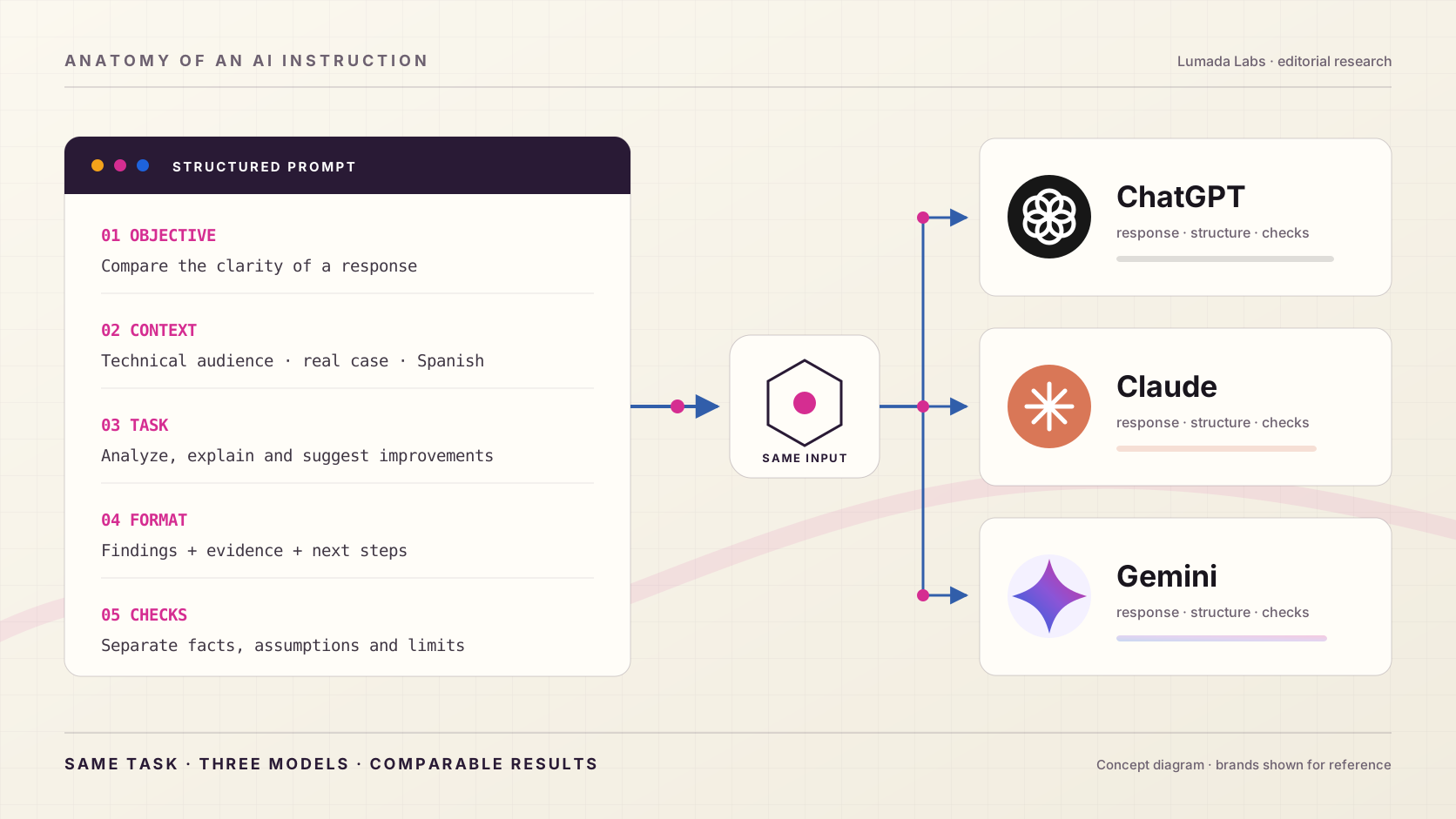
The analysis points to six parts.
- Objective. The result you want.
- Context. Why it matters, who it is for and what information is available.
- Input. The text, data, files or variables to process.
- Task. Concrete actions and their order where needed.
- Format. Structure, length, tone and level of detail.
- Checks. Limits, sources, assumptions and final review.
A simple question may fit in one line. The structure matters more when a task is ambiguous, repeatable, costly or sensitive to errors.
What changes across ChatGPT, Claude and Gemini
The general recommendations converge, but each product has its own capabilities and behavior. A reusable template should keep its goal, context and format. Adapt tools, context length, examples or system instructions to the model and task.
Design an instruction another person could follow without guessing the essentials. Try it with a real case and adjust it based on what happens.
Sources
- OpenAI prompt engineering best practices.
- Anthropic prompting best practices.
- Google prompt design strategies for Gemini.
- Lumada Labs prompt library, the corpus reviewed for this analysis.
Authorship, review and corrections
Priscila Soares conducted the editorial analysis and wrote this article. Lumada Labs checked the links, counts and whether the cited sources supported the claims. AI helped organize drafts. People reviewed the corpus selection, verification and published version.
Read our editorial and corrections policy. If you find a detail that needs review, email us at hola@lumadalabs.com and include the URL and passage.